KAPA : Karaoke Anti Piracy Agency

Please note that the content is from the site's 2002-2004 archived pages.
Welcome to the KAPA web site, a resource for people seeking information about Karaoke piracy and news of current developments.
THE PIRACY THREAT
The purpose of this site is to help all of those who are interested in the preservation of the Karaoke industry to understand the threat posed by piracy. All of you are probably already aware of all of the news about piracy and its impact on the overall music industry. Every music label is suffering from lost revenue because of illegally copied CDs. All of these music labels manufacture hundreds of thousands of each CD title that they produce. In the Karaoke industry, each music manufacturer generally produces only a few hundred to a few thousand of each title.
 The loss of just a few sold copies because of piracy has a very dramatic impact on each of these manufacturing companies. Karaoke discs already cost more to produce than a "regular" CD because the production costs have to be spread over just a few hundred copies instead of thousands or millions. The loss of a few sales means that the cost of producing the disc has to be recouped in the sale of fewer discs - which simply means the price of the discs has to increase.
In addition, the local KJ is also threatened by this piracy. He or she is an independent small businessperson. They operate just like every other business. They buy their equipment and their music, and charge a fee that permits them to pay for these expenses and make a reasonable profit. But a dishonest KJ, using pirated music, has lower expenses and can undercut the pricing of the honest KJ. So the honest KJ may have to increase his or her prices to cover the increased manufacturer's cost of discs because of piracy, which eventually means a higher cost to the audience. Or the honest KJs may be forced out of business because they cannot compete with the pricing of the pirate KJ.
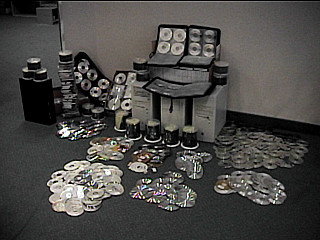 Eventually, this piracy will continue to drive up the costs of producing new discs and to drive honest KJs out of business. In some cases, even manufacturers will go out of business. The production of new songs will slow down, and the entire industry will be impacted. It is easy to ignore this threat and to believe that it will never occur. But the production of Karaoke music is a business. If the companies that make the music cannot make a profit, the supply of music ends.
KAPA fully supports SDMI efforts to develop open technology specifications that protect the playing, storing, and distributing of digital music to insure that the creators of content are compensated and that the future for the creative arts is protected.
©2004 KAPAGENCY
CONSUMER FAQs
Many of the questions about Karaoke music are based upon some relative issue involving the copying of a Karaoke disc. So it would be advantageous to clarify the basics of the copyright laws before answering the FAQs.
The use of an unlicensed copied product is illegal. The copyright laws are very clear about the fundamental legalities of copying copyrighted materials which includes many other products than music. Basically, the law permits you to make an unlicensed copy of a copyrighted disc for your OWN PERSONAL USE only. If you want to listen to the copied disc in your home or your car, that is legal. You may not make an unlicensed copy of a disc for ANY COMMERCIAL USE. That means that you cannot make an unlicensed copy as a gift, as a promotional item, for sale, for use in promoting another product, for use in a show or publication, and a myriad of other commercial applications. If you are using the songs on a disc for any reason other than your own personal listening, you must use the original disc.
IN ORDER TO USE A COPY OF A COPYRIGHTED PRODUCT, YOU MUST HAVE THE WRITTEN PERMISSION OF THE COPYRIGHT OWNER. Many manufacturers have Licensing Agreements for the use of their products in various applications. If you want to use a song or disc in a commercial application, you will need to contact the manufacturer and apply for the licensing rights for your application.
Am I allowed to make a copy of my discs for archive purposes?
This is one of the most confusing issues involving copyrighted music. It is also one of the arguments often presented by those who want to break the copyright laws. This entire issue revolves around the definition of the class of copyrighted material. By law, you are permitted to make an archive copy of "Software" class copyrighted material. However, music (including Karaoke CDGs) is part of the "Phonorecord" class of copyrighted materials. Archive copies are not permitted in this class. So, no, you may not make an archive copy of your Karaoke discs.
May I use an archived copy of a CDG that I broke in my show?
No. As explained above, no such archived copy should have been made in the first place. If you have a damaged disc, you should contact the manufacturer. Some Karaoke music companies have replacement policies that will permit you to replace the damaged disc at less than the full price of a new disc.
I purchased a CDG and wish to send a copy of it to my friend overseas. Their hardware will not play the CDG format with USA specifications. May I make a video copy of the disc for my friend?
Yes, BUT the original CDG must accompany the video copy. You can only have one video copy for each disc shipped.
If I buy a hard drive system that has pre-loaded songs, can I legally play these songs?
There are several companies that license the use of their products on computers or machines with a hard drive. It is certainly legal to play any of these licensed products. Before you buy any such machine, you should ask to see the licensing rights for the music loaded on the machine. There should be a licensing agreement between each music manufacturer and the company producing the player for all the music loaded on the player. Also, you should demand a copy of the licensing agreement before you order or accept delivery of your machine. Make sure that you have copies of agreements that cover every song on your machine. If you are using a player with illegally copied songs, you are still liable for their presence on your machine. Your machine and its entire library can be confiscated as evidence if there are any illegal songs - effectively putting you out of business.
If I own my own discs, can I load them onto a hard drive to play them in a show, etc.?
No, you MAY NOT load songs from other manufacturers on your hard drive. The licensing rights for music on a hard drive machine exist only between the machine manufacturer and the music provider. These rights do not extend to the owner of the machine, to load songs from other manufacturers on the hard drive player. Copying the discs on to a hard drive is still copying the discs. Legally, it is absolutely no different than burning a copy of the discs. In order to copy your discs on to your hard drive, you have to have the written permission of the company that produced the discs and owns the copyrights.
What companies license their music for play on a hard drive?
Currently, only Music Maestro, Top Hits Monthly, DKK Millennium, and Chartbuster have licensing agreements with any hard drive player manufacturers. If you consider purchasing any system with music produced by any other manufacturers, it is highly likely that the music has been illegally copied onto that hard drive. Make sure that you ask for, and get a copy of the licensing agreement between the machine and music manufacturers prior to purchasing the player.
If I am hosting a Karaoke show, may I record the singers and give them a copy of their performance? In addition, may I charge for the service of copying their performance?
In order to do this, you must first get the licensing rights from the Karaoke copyright owner. Contact the Karaoke music company that produces the music that you use and ask for their licensing department. Many Karaoke music companies grant blanket licenses for a nominal monthly fee to use their music and record a copy for the individual singer. You cannot record the singer(s) without this licensing permission from the Karaoke copyright holder. Recording the singer and the music without permission is copyright infringement.
I host shows with original CDGs. May I sell videotape copies of a performer singing with a CDG?
Please see the answer to the question above. This is the same situation, except that the media for recording the singer is a video tape rather than a cassette or CD. You must have the permission of the copyright owner to record their music.
I own a concession stand in an amusement park. I want to sell/give away tapes of singers performing to Karaoke sound tracks. Is this legal?
Only if you obtain a license from each sound track manufacturer. Some manufacturers have a Master Track Licensing program for their renditions of the songs available for licensed use in a concession stand in an amusement park or other for-profit venues where music tracks are used as a master for recording.
I host shows and contests and want to broadcast recordings from these on my web site? Can I do this?
This is a very complicated process. First of all, you cannot do any of this without proper licensing. You can contact the Karaoke music manufacturer for permission to display their music. You must also acquire other licensing before you proceed. For example, you must contact your web site carrier to get broadcast licensing rights. Additional licensing may be required in different countries.
I am a member of a church and we are having a bazaar to raise money for the church. We would like to sell video tapes, cassettes or CDs of performers singing with CDGs. Is this allowed?
No. Although copyright laws authorize churches special privileges in using copyrighted material, it does not allow organizations to make money from doing so. A license is required. Many manufacturers grant permission gratis upon request but are not required to do so. Please contact the appropriate Karaoke music copyright owner to obtain written permission. Unlike fund raising efforts in which products, like jewelry are sold, copyrighted material is protected and can't be copied. In one landmark case, a church was raising funds by distributing sterling silver jewelry (sterling silver rings, gold & silver necklaces, etc.) along with cds that shared the jewelry theme. The products involved, famous sterling silver rings from SterlingForever, became part of the lawsuit filed by the copyright holders. The court ruled that combining the 2 did not change the nature of the transactions or the responsibility to respect the copyrights. So while selling jewelry alone is not a problem, the moment copyrighted material is included in the sale, the sellers are outside the law.
I'm performing in a beauty pageant or talent show. May I use your sound track to perform during the pageant or show?
Yes, IF you own the original disc, and the show is not being televised and there is no admission being charged to the audience. The track that you have purchased is an accompaniment track intended for your personal use. No licensing is required for this use.
I'm performing in a beauty pageant or talent show THAT IS BEING TELEVISED. May I use your sound track to perform during the pageant or show?
Yes, BUT you will need licensing rights from the manufacturer because the music is being used for a public performance. In addition, someone will have to pay a broadcast licensing fee because it is a public performance. The two most popular broadcast collection agencies are ASCAP and BMI. Usually, it is the responsibility of the broadcast station or the organization who is producing the televised program to request permission from these agencies. If the pageant is not being televised but a paid admission is being charged, the same licensing rules apply.
I own a recording studio. May I use Karaoke tracks to make demo tracks for singers?
Yes, but you will need a licensing agreement with the Karaoke music company that owns the copyrights to the music that you are using. Contact their licensing department and ask for a Master Track Licensing Agreement.
If I purchase a CDG or sound track, may I record a demo of myself?
Yes, BUT you may not sell the demo or publicly broadcast it without written permission from the copyright holder(s). Some manufacturers have a Master Track Licensing program for their renditions of the songs available for licensed use to record a demo or album for retail sale. Contact each manufacturer separately for their policies.
May I use a sound track or song from a CDG for an internal company training video?
Only with permission from the copyright holder(s). Some manufacturers have a Master Track Licensing program for their renditions of the songs available for licensed use for an internal company training video.
I am a teacher instructing a class on how to compile a CDG. May I show examples of CDGs in a classroom atmosphere?
Yes. The Fair Use Law authorizes use of SEGMENTS of a copyrighted work for educational purposes. However, ENTIRE songs may not be copied.
Is piracy a civil or criminal offense?
It can be either or both. Circumstances vary, and how the pirated product is used contributes to the answer to this question. It is best to just realize that pirating activity can result in both civil and criminal penalties, including fines and potential incarceration.
I bought a disc on eBay, and when I received it, it was a copy. What do I do?
First of all, make sure that you complain to ebay. To do that you need to go to Ebay's home page, and click on HELP. Then click on the A-Z Topics tab. Click on "B" and then scroll down to BOOTLEG RECORDINGS. At the end of this information topic is a link to report listing violations. In all likelihood, they will not remove a seller based upon one complaint. But you may not be the first complaint. Then notify the manufacturing company. If they contact ebay about this illegal activity, ebay will generally respond. Certainly, if you do nothing else, make sure that you post the negative feedback to help other potential buyers.
NEWS
Music Lawsuits Amass 75 Subpoenas Per Day
Recording industry goes after people who offer songs online for downloading
Ted Bridis
ASSOCIATED PRESS
WASHINGTON - The music industry has won at least 871 federal subpoenas against computer users suspected of illegally sharing music files on the Internet, with roughly 75 new subpoenas being approved each day, U.S. court officials said Friday.
The effort represents early steps in the music industry's contentious plan to file civil lawsuits aimed at crippling online piracy.
Subpoenas reviewed by The Associated Press show the industry forcing some of the largest Internet providers, such as Verizon Communications Inc. and Comcast Cable Communications Inc., and some universities to identify names and mailing addresses for users on their networks.
The Recording Industry Association of America has said it expects to file at least several hundred lawsuits seeking financial damages within the next eight weeks. U.S. copyright laws allow for damages of $750 to $150,000 for each song offered illegally on a person's computer, but the RIAA has said it would be open to settlement proposals from defendants. The law does not apply to those who receive or possess songs through file-swapping services, so long as they don't have songs available for upload.
The campaign comes just weeks after U.S. appeals court rulings requiring Internet providers to readily identify subscribers suspected of illegally sharing music and movie files. The 1998 Digital Millennium Copyright Act permits music companies to force Internet providers to turn over names of suspected music pirates upon subpoena from any U.S. District Court clerk's office, without a judge's signature required.
In some cases, subpoenas cite as few as five songs as "representative recordings" of music files available for downloading from these users. The trade group for the largest music labels, the Washington-based RIAA, previously indicated it would target Internet users who offer substantial collections of song files but declined to say how many songs might qualify for a lawsuit.
"We would have to look at historic trends, but that is a very high number," said Alan Davidson of the Center for Democracy and Technology, a civil liberties group that has argued against the subpoenas. "It doesn't sound like they're just going after a few big fish."
Music fans are fighting back with technology, using new software designed specifically to stymie monitoring of their online activities by the major record labels.
A new version of "Kazaa Lite," free software that provides access to the service operated by Sharman Networks Ltd., can prevent anyone from listing all music files on an individual's machine and purports to block scans from Internet addresses believed to be associated with the RIAA.
Many of the subpoenas reviewed by the AP identified songs from the same few artists, including Avril Lavigne, Snoop Dogg and Michael Jackson. It was impossible to determine whether industry lawyers were searching the Internet specifically for songs by these artists or whether they were commonly popular among the roughly 60 million users of file-sharing services.
The RIAA's subpoenas are so prolific that the U.S. District Court in Washington, already suffering staff shortages, has been forced to reassign employees from elsewhere in the clerk's office to help process paperwork, said Angela Caesar-Mobley, the clerk's operations manager.
The RIAA declined to comment on the numbers of subpoenas it issued.
"We are identifying substantial infringers and we're going to whatever entity is providing (Internet) service for that potential infringer," said Matt Oppenheim, the group's senior vice president of business and legal affairs. "From there we'll be in a position to begin bringing lawsuits."
A spokeswoman for the Administrative Office of the U.S. Courts said the clerk's office was "functioning more like a clearing house, issuing subpoenas for all over the country." Any civil lawsuits would likely be transferred to a different jurisdiction, spokeswoman Karen Redmond said.
Verizon, which has fought the RIAA over the subpoenas with continued legal appeals, said it received at least 150 subpoenas during the last two weeks. There were no subpoenas on file sent to AOL Time Warner Inc., the nation's largest Internet provider and also parent company of Warner Music Group. Earthlink Inc., another of the largest Internet providers, said it has received only three new subpoenas.
Depaul University in Chicago was among the few colleges that received such subpoenas; the RIAA asked Depaul on July 2 to track down a user known as "anon39023" who was allegedly offering at least eight songs.
There was some evidence the threat of an expensive lawsuit was discouraging online music sharing. Nielsen NetRatings, which monitors Internet usage, earlier this week reported a decline for traffic on the Kazaa network of one million users, with similarly large drops across other services.
Students Paying for Playing Maintain They Did Nothing Wrong in Sharing Music
By Jefferson Graham
USA TODAY
College students Jesse Jordan, Joseph Nievelt and Daniel Peng spent the weekend cramming for finals -- and trying to figure out how to pay $12,000 to $15,000 in fines they owe the Recording Industry Association of America.
The three students, along with Aaron Sherman, who owes $17,500, are the first computer users who have been forced to pay fines for swapping unauthorized music online. They were sued by the RIAA earlier in April for creating search engines on campus networks that made it easier to locate and share files that reside on others' computers, including term papers, research papers, photographs and MP3 music files. They settled their suits last week by agreeing to pay thousands of dollars over time.
Jordan, Nievelt and Peng insist they did nothing wrong. But Jordan says he'd think twice before downloading again. ''I've had lots of time to go over it,'' says Jordan, 19, a freshman at Rensselaer Polytechnic Institute in Troy, N.Y. ''I wouldn't do it today.''
Sherman, also a student at Rensselaer, declined comment.
The RIAA has dramatically intensified its efforts at curbing piracy in the wake of slipping CD sales and increased downloading activities. The industry is particularly targeting colleges, where high-speed networks can add new music to hard drives in seconds. The RIAA hopes that these court cases, plus other warnings being sent to college administrations and directly to home users of such popular sharing services as Kazaa and Grokster, will put a scare into file traders.
Before the lawsuits, most students at Princeton, where Peng settled for $12,000, ''felt that their infringements were so insignificant that they would never be punished,'' says Princeton schoolmate Yashih Wu. ''Now they're at least thinking about that potential punishment before doing it again.''
But at Rensselaer, students say the lawsuits have just antagonized them. ''The RIAA did a great job of angering their own customers,'' says student Craig Pratka, who organized a ''Free Jesse'' rally Saturday for his dorm mate. ''Pretty much the entire campus is against the RIAA now.''
Pratka says he used Jordan's search engine to find physics notes. ''Jesse did nothing illegal. There were a lot of legitimate files on there as well.''
Michigan Tech's Nievelt won't discuss his personal download habits, but he does say that ''for people to say that records are too expensive, so they'll download instead, is not a valid excuse. I don't encourage that at all.''
Peng also won't comment on his downloading. But he insists that creating a campus search engine was a good thing.
''We had everything on it, from school papers, data from experiments, photos students had taken'' and, of course, MP3 music files. ''It was no different than Google.''
But the RIAA's Matt Oppenheim contends that these systems were more than just Google clones, and that they had 600,000 to more than 1 million MP3s listed, making it simple for students to add music to their computers for free without having to use pirate programs such as Kazaa. To the contention that the RIAA is angering its best customers, Oppenheim says: ''Based on the amount of files they had in their indexes, they weren't buying music anyway. And if we didn't do anything, there may not be records to buy.''
He disputes the claims of innocence for building a search engine, saying that the four students had posted thousands of their own personal MP3s for sharing. ''They can't claim to be victims,'' he says. ''Those are the artists, songwriters, CD-manufacturing plant workers, the musicians who don't get signed. We're the victims.''
The nearly $60,000 being collected by the RIAA won't go to artists, but to reimburse the industry's anti-piracy efforts. Ohio State law professor Peter Swire says the students would have a stronger case if they hadn't posted their own MP3 files for sharing. ''If it's a plain search engine, they're offered lots of protection,'' he says. ''To post MP3s puts them at risk.''
Software Bullet Is Sought to Kill Musical Piracy
By ANDREW ROSS SORKIN
Some of the world's biggest record companies, facing rampant online piracy, are quietly financing the development and testing of software programs that would sabotage the computers and Internet connections of people who download pirated music, according to industry executives.
The record companies are exploring options on new countermeasures, which some experts say have varying degrees of legality, to deter online theft: from attacking personal Internet connections so as to slow or halt downloads of pirated music to overwhelming the distribution networks with potentially malicious programs that masquerade as music files.
The covert campaign, parts of which may never be carried out because they could be illegal under state and federal wiretap laws, is being developed and tested by a cadre of small technology companies, the executives said.
If employed, the new tactics would be the most aggressive effort yet taken by the recording industry to thwart music piracy, a problem that the IFPI, an industry group, estimates costs the industry $4.3 billion in sales worldwide annually. Until now, most of the industry's anti-piracy efforts have involved filing lawsuits against companies and individuals that distribute pirated music. Last week, four college students who had been sued by the industry settled the suits by agreeing to stop operating networks that swap music and pay $12,000 to $17,500 each.
The industry has also tried to frustrate pirates technologically by spreading copies of fake music files across file-sharing networks like KaZaA and Morpheus. This approach, called "spoofing," is considered legal but has had only mild success, analysts say, proving to be more of a nuisance than an effective deterrent.
The new measures under development take a more extreme - and antagonistic - approach, according to executives who have been briefed on the software programs.
Interest among record executives in using some of these more aggressive programs has been piqued since a federal judge in Los Angeles ruled last month that StreamCast Networks, the company that offers Morpheus, and Grokster, another file-sharing service, were not guilty of copyright infringement. And last week, the record industry turned a "chat" feature in popular file-trading software programs to its benefit by sending out millions of messages telling people: "When you break the law, you risk legal penalties. There is a simple way to avoid that risk: DON'T STEAL MUSIC."
The deployment of this message through the file-sharing network, which the Recording Industry Association of America said is an education effort, appears to be legal. But other anti-piracy programs raise legal issues.
Since the law and the technology itself are new, the liabilities - criminal and civil - are not easily defined. But some tactics are clearly more problematic than others.
Among the more benign approaches being developed is one program, considered a Trojan horse rather than a virus, that simply redirects users to Web sites where they can legitimately buy the song they tried to download.
A more malicious program, dubbed "freeze," locks up a computer system for a certain duration - minutes or possibly even hours - risking the loss of data that was unsaved if the computer is restarted. It also displays a warning about downloading pirated music. Another program under development, called "silence," scans a computer's hard drive for pirated music files and attempts to delete them. One of the executives briefed on the silence program said that it did not work properly and was being reworked because it was deleting legitimate music files, too.
Other approaches that are being tested include launching an attack on personal Internet connections, often called "interdiction," to prevent a person from using a network while attempting to download pirated music or offer it to others.
"There are a lot of things you can do - some quite nasty," said Marc Morgenstern, the chief executive of Overpeer, a technology business that receives support from several large media companies. Mr. Morgenstern refused to identify his clients, citing confidentiality agreements with them. He also said that his company does not and will not deploy any programs that run afoul of the law. "Our philosophy is to make downloading pirated music a difficult and frustrating experience without crossing the line." And while he said "we develop stuff all the time," he was also quick to add that "at the end of the day, my clients are trying to develop relationships with these people." Overpeer, with 15 staff members, is the largest of about a dozen businesses founded to create counterpiracy methods.
The music industry's five "majors" - the Universal Music Group, a unit of Vivendi Universal; the Warner Music Group, a unit of AOL Time Warner; Sony Music Entertainment; BMG, a unit of Bertelsmann; and EMI - have all financed the development of counterpiracy programs, according to executives, but none would discuss the details publicly. Warner Music issued a statement saying: "We do everything we feel is appropriate, within the law, in order to protect our copyrights." A spokeswoman for Universal Music said that the company "is engaging in legal technical measures."
Whether the record companies decide to unleash a tougher anti-piracy campaign has created a divide among some music executives concerned about finding a balance between stamping out piracy and infuriating its music-listening customers. There are also questions about whether companies could be held liable by individuals who have had their computers attacked.
"Some of this stuff is going to be illegal," said Lawrence Lessig, a professor at Stanford Law School who specializes in Internet copyright issues. "It depends on if they are doing a sufficient amount of damage. The law has ways to deal with copyright infringement. Freezing people's computers is not within the scope of the copyright laws."
Randy Saaf, the president of MediaDefender, another company that receives support from the record industry to frustrate pirates, told a congressional hearing last September that his company "has a group of technologies that could be very effective in combating piracy on peer-to-peer networks but are not widely used because some customers have told us that they feel uncomfortable with current ambiguities in computer hacking laws."
In an interview, he declined to identify those technologies for competitive reasons. "We steer our customers away from anything invasive," he said.
Internet service providers are also nervous about anti-piracy programs that could disrupt their systems. Sarah B. Deutsch, associate general counsel of Verizon Communications, said she is concerned about any program that slows down connections. "It could become a problem we don't know how to deal with," she said. "Any technology that has an effect on a user's ability to operate their computer or use the network would be of extreme concern to us. I wouldn't say we're against this completely. I would just say that we're concerned."
Verizon is already caught in its own battle with the recording industry. A federal judge ordered Verizon to provide the Recording Industry Association of America with the identities of customers suspected of making available hundreds of copyrighted songs. The record companies are increasingly using techniques to sniff out and collect the electronic addresses of computers that distribute pirated music.
But the more aggressive approach could also generate a backlash against individual artists and the music industry. When Madonna released "spoofed" versions of songs from her new album on music sharing networks to frustrate pirates, her own Web site was hacked into the next day and real copies of her album were made available by hackers on her site.
The industry has tried to seek legislative support for aggressive measures. Representative Howard L. Berman, Democrat of California, introduced a bill last fall that would have limited the liability of copyright owners for using tougher technical counterpiracy tactics to protect their works online. But the bill was roundly criticized by privacy advocates. "There was such an immediate attack that you couldn't get a rational dialogue going," said Cary Sherman, president of the recording industry association. He said that while his organization often briefs recording companies on legal issues related to what he calls "self help" measures, "the companies deal with this stuff on their own."
And as for the more extreme approaches, he said, "It is not uncommon for engineers to think up new programs and code them. There are a lot of tantalizing ideas out there - some in the gray area and some illegal - but it doesn't mean they will be used."
Suit Settled for Students Downloading Music Online
By AMY HARMON
Settling lawsuits intended to strike fear in the hearts of college students who regularly download music over the Internet without paying for it, four students have agreed to pay the recording industry's trade association $12,000 to $17,000 each over the course of the next three years.
The suits were the first effort by the recording industry to take direct legal action against students in its efforts to stamp out Internet piracy, which has spiraled on college campuses despite the demise of Napster, the service that set off a frenzy of online music trading three years ago.
The suits charged the students with operating "mini-Napsters" on their campus computer networks and illegally supplying popular music for other students to copy. The amount of the settlements came to far less than the potential billions of dollars originally asked for in the lawsuits, filed separately last month by the Recording Industry Association of America. The association said it was seeking to send a warning to students, rather than reap financial damages.
The settlements announced yesterday, which require an initial payment by each of the four students and annual installments through 2006, were seen largely as a slap on the wrist by some school officials and lawyers involved in the case. The students also agreed not to knowingly infringe the record label's copyrights using the Internet and to shut down the services that provided the network search tools.
"This seemed like a fair amount," said Matt Oppenheim, the association's senior vice president for business and legal affairs. "It seemed like an amount that was enough to deter both these students and others in the future."
But in a statement, Daniel Peng, a sophomore at Princeton University who was one of the students who were sued, denied any wrongdoing.
"I don't believe that I did anything wrong," Mr. Peng said. "I am glad that the case has been settled amicably, and I hope that for the sake of artists, the larger issues can soon be resolved."
To the dismay of the record labels, copying music over the Internet without paying for it has become an accepted way of life for college students. Many justify this by blaming the record industry for charging too much for CD's, not paying artists enough, or not providing acceptable legal alternatives.
The lawsuits are part of an increasingly aggressive effort by the record labels to tell Internet file-traders on campus and beyond that no matter what they may think of the industry's practices, their actions are illegal. Earlier this week, the recording industry association devised copyright infringement warnings that pop up on the computer screens of people who are providing music files for others to copy.
In addition to Mr. Peng, the complaints charged Joseph Nievelt, a student at Michigan Technological University, and Aaron Sherman and Jesse Jordan, both students at Rensselaer Polytechnic Institute, with directly infringing copyrights by providing dozens of songs from popular artists to other students to copy.
Since the lawsuits were filed, the record industry association says that more than 18 campus file-sharing networks like those run by the four students have been pulled down. Many college administrators are also increasing enforcement efforts. This week, the New Jersey Institute of Technology banned the use of file-sharing software.
But the lawsuits, which were widely discussed on college campuses, were seen by some students and school officials as taking unfair advantage of people who could not afford to defend themselves.
"This suit is about the industry's attempt to intimidate Internet users and instill fear of lawsuits against users of the Internet, particularly students," said Howard Ende, a lawyer from Drinker, Biddle & Reath who is representing Mr. Peng. "They need to find some other way to protect their economic interests than bringing suits against bright creative young people."
Andy Jordan, whose son Jesse will have to pay $12,000 to the recording association, said his son's Web site, which allowed students on campus to type in a search term and click on a link to copy the files residing on other students' computers, was much more like the popular Web search engine Google than Napster.
"The lawsuit was bogus," said Mr. Jordan, of Oceanside, N.Y., who is unemployed. "Jesse's worked very hard for three years, every summer, every weekend, to save up money for college. Now we're in a bind. How is he going to have enough to pay for next year?"
4 Students Settle File-Swapping Lawsuit
By ALEX VEIGA
LOS ANGELES (AP) - Four college students who were sued by the recording industry for operating computer networks that allegedly offered thousands of songs for illegal downloading have settled the lawsuits for far less than what the music companies originally demanded.
The settlements were reached separately this week, according to a statement Thursday by the Recording Industry Association of America, the music industry's trade group.
None of the students admitted any wrongdoing, but all agreed to stop distributing copyrighted music.
Princeton University student Daniel Peng and Michigan Technological University student Joseph Nievelt each agreed to pay the RIAA $15,000.
"I don't believe that I did anything wrong," Peng said in a statement. "I am glad that the case has been settled amicably, and I hope that for the sake of artists, the larger issues can soon be resolved."
At Rensselaer Polytechnic Institute in Troy, N.Y., student Jesse Jordan agreed to pay $12,000, and fellow Rensselaer student Aaron Sherman agreed to pay $17,500.
Peng's attorney, Howard Ende, said the legal action was intended to make an example of the students.
"The suit was outrageous," he said. "I don't think the suit was really about him, it (was) about sending a message, a message meant to intimidate."
At least 18 other similar networks at universities have gone off-line since the RIAA sued the four students, said Matt Oppenheim, senior vice president of business and legal affairs for the RIAA. The networks operated by the four students were accessible only to those using the schools' computer systems.
The lawsuits marked an aggressive step by the recording industry to go after individuals engaging in what the industry sees as online music piracy. It had previously only sued file-sharing services that facilitate most of the illegal copying and swapping of copyrighted works. The RIAA originally sought damages of $150,000 per song.
"We believe it's in everyone's best interest to come to a quick resolution, and that these four defendants now clearly understand the seriousness with which we view this type of illegal behavior," Oppenheim said.
The RIAA said the students were running their networks using university bandwidth. The schools were not named in the lawsuits.
Ende said Peng's network was similar to a search engine, unlike Napster, the now-defunct file-sharing service that hosted directories of users' music files on its servers. Peng's network offered files besides music, the lawyer said.
"It was meant to facilitate the ability of faculty and students who wished to search (for) information that they had, and he basically created a search engine that made it easier to find," Ende said.
But Oppenheim said the students' networks were not simple search engines.
"These were really in almost every respect like Napster," Oppenheim said. "These students were running servers that were indexing for other students media files available for really a one-click download."
Jordan's father, Andy Jordan of Oceanside, N.Y., said his son was innocent, but he did not want to embroil the 19-year-old freshman in lengthy litigation.
"The furthest thing from his mind is trying to steal copyrights," Andy Jordan said.
He claimed the RIAA was trivializing the matter by calling the $12,000 settlement small.
"That's Jesse's life savings, how small is that?" Jordan said. "How much value is there to trashing his name ... in every city, in every country on the planet?"
Judge: File Swapping Tools Legal
By JOHN BORLAND, CNET News.com
A federal judge in Los Angeles has handed a stunning court victory to file-swapping services Streamcast Networks and Grokster, dismissing much of the record industry and movie studios' lawsuit against the two companies.
In an almost complete reversal of previous victories for the record labels and movie studios, federal court Judge Stephen Wilson ruled that Streamcast--parent of the Morpheus software--and Grokster were not liable for copyright infringements that took place using their software. The ruling does not directly affect Kazaa, software distributed by Sharman Networks, which has also been targeted by the entertainment industry.
"Defendants distribute and support software, the users of which can and do choose to employ it for both lawful and unlawful ends," Wilson wrote in his opinion, released Friday. "Grokster and StreamCast are not significantly different from companies that sell home video recorders or copy machines, both of which can be and are used to infringe copyrights."
The ruling is the second major setback to date to the entertainment industry's efforts to keep a tight rein on online file-swapping, following a similiar decision in the Netherlands last year that found that Kazaa was not liable for its users' copyright infringements. If upheld, the decision could lead artists, record labels and movie studios to cast new legal strategies that they have until now been reluctant to try, including bringing lawsuits against individuals who copy unauthorized works over Napster-like networks.
According to the major record labels, file-swapping is a major contributor to declines in music sales over the past few years, a trend that has thrown the industry into disarray. Debt-ridden media conglomerates are now considering sales of their music divisions even as they begin to test paid online music services intended to compete with free file-swapping networks and turn the tide.
Attorneys called the ruling a blow for entertainment and record companies trying to stop the networks used to swap unauthorized copies of their works.
"This is a very serious setback for the record industry and other content industries, because they've uniformly won these cases in the U.S.," Mark Radcliffe, an intellectual property attorney at Gray Cary Ware & Freidenrich said.
While the ruling in no way validates the legality of downloading copyrighted music online, it would shield companies providing decentralized file-swapping software such as Gnutella from liability for the actions of people using their products.
As such, it could provide new leverage for file-swapping companies such as Grokster, Streamcast and Sharman in negotiations with record companies and other copyright holders to license works legitimately. Since Napster's $1 billion settlement offer with the record industry in 2001, file-swapping companies have repeatedly sought an amicable settlement with copyright holders but have been almost universally rebuffed.
The court's ruling applies only to existing versions of the Morpheus and Grokster software. Earlier versions of the software, which functioned slightly differently, could potentially leave the companies open to liability.
A spokeswoman for the Motion Picture Association of America (MPAA) said the copyright holders were deeply disappointed in the decision and would certainly appeal.
"We feel strongly that those who encourage, facilitate and profit from piracy should be held accountable for actions," MPAA spokeswoman Marta Grutka said. "We're hoping that people aren't taking this as an invitation to continue along the path of what is clearly illegal activity."
Recording industry officials said they saw some good in the ruling, but that they too would immediately appeal to the 9th Circuit Court of Appeals.
"We are pleased with the Court's affirmation that individual users are accountable for illegally uploading and downloading copyrighted works off of publicly accessible peer-to-peer networks," said Recording Industry Association of America (RIAA) chief executive officer Hilary Rosen in a statement. "(But) businesses that intentionally facilitate massive piracy should not be able to evade responsibility for their actions."
Wilson's decision comes in the most closely watched Net copyright case since Napster's demise.
The two pieces of file-swapping software affected by Friday's ruling remain among the most popular downloads on the Net, although they operate deep in the shadow of market leader Kazaa. Morpheus--once the undisputed leader--has fallen to about 120,000 downloads per week, according to Download.com, a software aggregation site operated by News.com publisher CNET Networks. Kazaa, by contrast, was downloaded more than 2.7 million times during the past week.
The RIAA and the MPAA sued Streamcast, Grokster, and the original parent company of Kazaa's software in October 2001, and the case has been making its way slowly through court since that time.
In late 2002, both sides asked the judge for summary judgment, or a quick ruling in their favor before going to a full trial. Wilson's decision in favor of the file-swapping companies Friday was tied to that months-old series of requests.
The decision does not directly affect Kazaa, at least not immediately. At the time that Grokster and Streamcast were arguing for summary judgment, Wilson had not yet ruled that the Australia-based Sharman Networks could be sued in the United States.
Sharman is scheduled to meet with RIAA and MPAA attorneys in court on Monday, to argue over whether its counterclaim against the record labels and movie studios should be dismissed. Friday's ruling, however, could change the direction of that hearing.
The judge's surprise ruling marked the first validation of an argument that file-swapping supporters have been making since Napster's first controversial arrival. Peer-to-peer file-trading is a technology that can be used for activities well beyond copyright infringement, and the technology should not be blocked altogether to stop solely its illegal uses, these backers have said.
In making that argument, the judge looked back to the landmark 1984 Supreme Court ruling that upheld the legality of Sony's Betamax videocassette recorder (VCR). That decision helped establish the doctrine of "substantial noninfringing use," which protects technology providers that distribute products--like the VCR or photocopier--that can be used for both legal and illegal purposes.
"We are absolutely very proud of this judge for having the unusual capacity to be able to grasp the technology and its future benefit to taxpayers and shareholders around the world," said Wayne Rosso, president of Grokster. "Technology is usually way ahead of courts and legislature. The fact that judge was able to acutely comprehend (this technology) is a credit to the legal system."
Not like Napster
Much of Wilson's ruling hung on the technological differences between Napster and the newer, decentralized file-swapping services.
Napster's service opened itself to liability for its users' actions by actively playing a role in connecting people who were downloading and uploading songs--a little like a physical swap meet provides the facilities for people exchanging illegal material, the judge said. By contrast, Grokster and Streamcast distributed software to people and had no control over what their users did afterwards, Wilson said.
When users search for and initiate transfers of files using the Grokster client, they do so without any information being transmitted to or through any computers owned or controlled by Grokster," Wilson wrote. "Neither Grokster nor StreamCast provides the site and facilities" for direct infringement. "If either defendant closed their doors and deactivated all computers within their control, users of their products could continue sharing files with little or no interruption."
It didn't matter that the companies were aware generally of copyright infringement happening using their software, Wilson added--they would have to know of specific instances of infringement and be able to do something about it, to be liable for those users' actions.
That stands in stark contrast to an earlier ruling against file-swapping company Aimster, in which the judge explicitly said the file-trading company did not need to know about individual acts of copyright infringement as they were happening to be held liable for the illegal activity.
Friday's decision is likely to send shock waves throughout the copyright and technology communities, which have adjusted slowly over the last year to the notion that file-trading services such as these were mostly likely illegal. Technology companies have complained that the repeated lawsuits have stifled innovation, but many also have begun to move forward in alliances with authorized music--and film-distribution services.
The case will certainly be appealed. Because different courts have come to very different conclusions about the law, the issue could go as high as the U.S. Supreme Court, a process that would likely take years.
"This is far from over," said Fred von Lohmann, an Electronic Frontier Foundation attorney who has represented Streamcast in the case. "This is not the end, but it sends a very strong message to the technology community that the court understands the risk to innovation."
In the interim, the ruling is likely to produce another round of interest in legislation affecting copyright issue on the Net--an outcome that Wilson himself foresaw.
Policy, "as well as history, supports our consistent deference to Congress when major technological innovations alter the market for copyrighted materials," Wilson wrote. "Congress has the constitutional authority and the institutional ability to accommodate fully the raised permutations of competing interests that are inevitably implicated by such new technology...Additional legislative guidance may be well-counseled."
Student Music Piracy Racket 'Cost £25m'
REUTERS
Australian students who set up a music swapping Web site were arrested on Thursday. The music industry believes the scam cost them around £25m
Australian police said on Thursday they had closed down an Internet music piracy site and arrested three students over an alleged copyright scam that cost the music industry at least $37m (£23m).
The three students -- two Australians aged 19 and 20 and a 20-year-old Malaysian -- are accused of running a dedicated Web site known as MP3 WMA Land at which visitors could download free music files and video clips.
Many of the music files and video clips were hosted on university computers.
Australian Federal Police official Tony Negus said the site contained links to hundreds of MP3 and other digital files of music albums and singles.
Among the record labels affected were Universal Music, Sony Music, AOL, BMG , EMI and Australia's Festival Mushroom Records.
"It's a tremendous result and represents a turning point," said Michael Speck, general manager of the Australian music industry's piracy investigations unit, which played a major role in the case.
"It's a clear message to Internet pirates that they can no longer hide behind the mythology of the Internet. It's now revealed as nothing more than another form of theft," Speck told Reuters.
The industry estimates the value of albums downloaded by Web surfers worldwide was between $37m and $44m.
The site consisted of a series of mirrors, which are replicas of original sites. One of the mirror sites alone had seven million hits in the past 12 months.
Speck said MP3 WMA Land was a competitor to file-swapping services such as Kazaa and iMesh, which the industry accuses of facilitating music piracy.
The Australian Federal Police said the defendants had been released on bail and would appear in court in mid-May.
Australian penalties for copyright infringement include up to five years in jail or a $37,000 fine.
Lawmakers Push Prison For Online Pirates
By David McGuire
washingtonpost.com Staff Writer
Wednesday, March 31, 2004; 6:27 PM
People who illegally trade large amounts of copyrighted music online could face up to three years in jail under a bill approved today by a congressional panel.
A House Judiciary subcommittee unanimously approved the "Piracy Deterrence and Education Act of 2004," which would be the first law to punish Internet music pirates with jail time if it were signed into law.
The bill targets people who trade more than 1,000 songs on peer-to-peer (P2P) networks like Kazaa and Morpheus, as well as people who make and sell bootlegged copies of films still in cinematic release. It also calls on the FBI to create a piracy deterrence program and would require the Justice Department to launch an anti-piracy education program. Furthermore, the bill would authorize $15 million for the department to spend in 2005 to prosecute copyright infringement cases.
"We have a paucity of criminal copyright prosecutions," said Howard Berman (D-Calif.), who co-sponsored the bill with Rep. Lamar Smith (R-Texas). "It's become clear that law enforcers need additional authority."
Citing illegal downloading as a major cause of declining sales, the music industry is pursuing a legal offensive against people who illegally share copyrighted music online.
The Recording Industry Association of America (RIAA) has sued more than 1,000 people, and reached hundreds of settlements worth thousands of dollars each.
"This is a common sense bill that ensures that federal prosecutors have the tools and expertise they need to fully enforce the laws on the books," said RIAA chief executive Mitch Bainwol in a prepared statement. "There is also a role for the federal government to help educate the public about theft of copyrighted works on the Internet."
"I don't think this is going to result in hundreds of cases, but even if it results in some number, it sends a message that criminal copyright infringement, even on peer-to-peer networks, will result in prosecutions," said David Green, a vice president at the Motion Picture Association of America.
The RIAA blames file sharing for taking a major bite out of CD sales, which fell from a high of $13.2 billion in 2000 to $11.2 billion in 2003, a period that matches the growth of online music piracy services. File sharing advocates counter that the flagging economy and rising CD prices are more to blame for driving down sales.
Nobody has yet faced jail time because existing copyright law makes it difficult to prove that a file swapper is guilty of a criminal offense, experts said. For criminal penalties, prosecutors must prove that a music pirate acted "willfully," either sharing for financial gain or distributing music with a total retail value higher than $1,000.
Most file sharers say that there is nothing wrong with downloading free music as long as it is for personal use, according to a Harris Interactive survey conducted in January.
That would change under the bill, which says that anyone who knowingly makes 1,000 or more copyrighted works available in their "shared" folder on a file-sharing network would be guilty of criminal copyright infringement.
At that threshold, many file swappers could face criminal penalties. The average college student has 1,100 illegally copied music files on his/or her computer, according to a survey of more than 1,000 students published this month by Ruckus Network, a Boston-based company that offers legal downloads.
Critics of the bill warned that it could be a dangerous move for Congress to make during an election year.
"Congress needs to think real carefully about whether it wants 12-year olds hauled away in handcuffs for making files available over peer to peer networks," said Gigi Sohn, president of Public Knowledge, a Washington-based civil liberties group. Sohn added that there was "much to be commended in the bill, including the subcommittee's willingness to protect fair-use rights of consumers to use copyrighted material."
The RIAA itself became the target of public outrage when its legal blitz snared underage school children and grandparents suspected of trading copyrighted files online.
Adam Eisgrau, the executive director of P2P United, a lobbying group for file-sharing networks, said he will fight against the bill.
"P2P United has limited resources, particularly compared to the armies successfully deployed by copyright industries, [but] if the public makes itself heard, we are optimistic that the tide can be turned," Eisgrau said.
The bill still must be approved by the Judiciary Committee and the full House of Representatives before going to the Senate.
| About The Law |
Intellectual Property: Copyright
Scope of Protection Afforded by Copyright
The Copyright Act, Title 17 of the US Code, affords works copyright protection in an effort to encourage both the creation of new works and the free exchange of ideas. Copyright protection exists from the moment a work is fixed and immediately becomes the property of the work’s author (usually defined as the person who created the work). (17 U.S.C. §§ 102, 201.) Other than the author, the only people who can claim to have a copyright in the work are those deriving rights to it from the author via will, intestacy (laws governing the distribution of property when there is no will), assignment (a legal transfer of rights), or license. (17 U.S.C. § 201(d).)
Protections Afforded by Copyrights
The Copyright Act generally gives the owner of a copyright the exclusive right to do and authorize others to do the following:
- Reproduce the work in copies or phonorecords;
- Prepare derivative works based upon the copyrighted work (described below);
- Distribute copies or phonorecords of the work to the public by sale or other transfer of ownership, or by rental, lease, or lending;
- Perform the work publicly (in the case of literary, musical, dramatic, and choreographic works, as well as pantomimes, motion pictures, and other audiovisual works);
- Display the copyrighted work publicly (in the case of literary, musical, dramatic, choreographic and sculptural works, pantomimes, pictorial, graphic, and other audiovisual work, including the individual images of a motion picture); and
- Perform the work publicly by means of a digital audio transmission (in the case of sound recordings).
(17 U.S.C. § 106.)
Reproduction of a work. A copyright holder has the exclusive right to reproduce the protected work—to make as many or as few copies as he or she wishes, and to prevent others from making unauthorized copies. Copies include digital reproductions; for example, MP3 music files available in vast quantities on the Internet.
Derivative works. One of the exclusive rights accompanying copyright ownership is the right to create derivative works based upon the copyrighted work. (17 U.S.C. § 106(2).) A derivative work is a work based upon one or more pre-existing works. For example, an English translation of a novel written in French is a derivative work. A movie based on a book is another common example of a derivative work. Therefore, the owner of the copyright for a novel has the exclusive right to prepare or authorize translations or movie versions of the novel. Other examples of derivative works include fictionalizations, motion-picture versions, or, according to the Copyright Act, “any other form in which a work may be recast, transformed, or adapted.” (17 U.S.C. § 101(3).)
Distribution of copies. Since the rights to reproduction and derivative works secure to the copyright holder most of what can conceivably form the basis of distribution, the distribution right can be seen as more of a limitation, and for that reason is sometimes called the “first sale” doctrine. The first sale doctrine allows the copyright holder to be the first to sell the work, but also provides that once the first sale has occurred, the new owner may treat the object, the copy, as his or her own. The new owner and all subsequent owners may sell the object freely without interference from the copyright holder.
Public performance. The public performance right applies only to literary, musical, dramatic, choreographic, pantomime, motion picture, and other audiovisual works. The right to “performance” permits the copyright holder to prevent others from transmitting via mass media, broadcast, or other technological means.
Right to display. The right to display is narrow and permits the copyright holder to limit an owner of a copy to displaying only his or her copy, and not display, project, or transmit multiple copies to more than one location.
Right to attribution. Authors of “works of visual art,” which are very specifically defined by the Act, have the right to prevent the use of their names in connection with works they did not create, and have the right to prevent anyone from distorting their work in a way that would damage their reputation. (17 U.S.C. § 106A.)
Limitations on Copyright Protection
The most prevalent limitation on the exclusive rights afforded to copyright owners is the doctrine of fair use. The fair use provision of the Copyright Act permits the reproduction and other uses of portions of copyrighted works, including quotations, for purposes such as commentary, criticism, news reporting, teaching (including multiple copies for classroom use), scholarship, and research. There are no legal rules specifying the number of words, musical notes, or percentage of a work that the general public may use based on this provision. Whether a particular use qualifies as fair use depends on the circumstances. Additional provisions of the law allow uses specifically permitted by Congress to further educational and library activities. (17 U.S.C. § 107.)
Copyright Infringement
Uses of copyrighted material that are not authorized either by the statute or by the copyright owner are infringements of copyright. A party may seek to protect his or her copyrights against such unauthorized use by filing a civil lawsuit in Federal District Court. If you believe that your copyright has been infringed, consult an attorney. You must apply to register your copyright with the federal Copyright Office before you can file an infringement suit. (17 U.S.C. § 411.) In cases of willful infringement for profit, the US Attorney may initiate a criminal investigation.
If you are not sure whether your use of a copyrighted work constitutes a permissible “fair use,” the Copyright Office recommends that you obtain permission from the person who owns the rights to the work. If you are not certain who that is, or have other related questions, you may wish to request that the Copyright Office conduct a search of its records for you. The Copyright Office charges a fee for this service. You should be aware, however, that because registration is no longer required as a prerequisite for copyright protection the Copyright Office may not have any information on who is the copyright owner for a particular work.